Members of the Paleoceanography Research Group frequently lead and partipicate in large international research cruises, mostly in the North Atlantic region and circum-Greenland waters.
Several recent expeditions are listed below. Full details can be found in the cruise report files, and an overview of all marine sediment samples is shown here.
The multidisciplinary AOC (Atlantic-Arctic Ocean Change) Cruise in May 2025 on RV Dana was to the southern Greenland Sea, in particular waters west and northwest of Jan Mayen. The focus was on: i) tracing the path of freshwater from sea ice melt and the east Greenland current into the Greenland Sea, ii) studying the optical properties and characteristics of the spring phytoplankton bloom, iii) quantifying the impact of associated zooplankton grazing and vertical fluxes of carbon, iv) investigating the production and character of volatile organic carbon released by the bloom, and v) mapping the seafloor and collecting sediment cores to derive reconstructions of conditions during the Holocene.
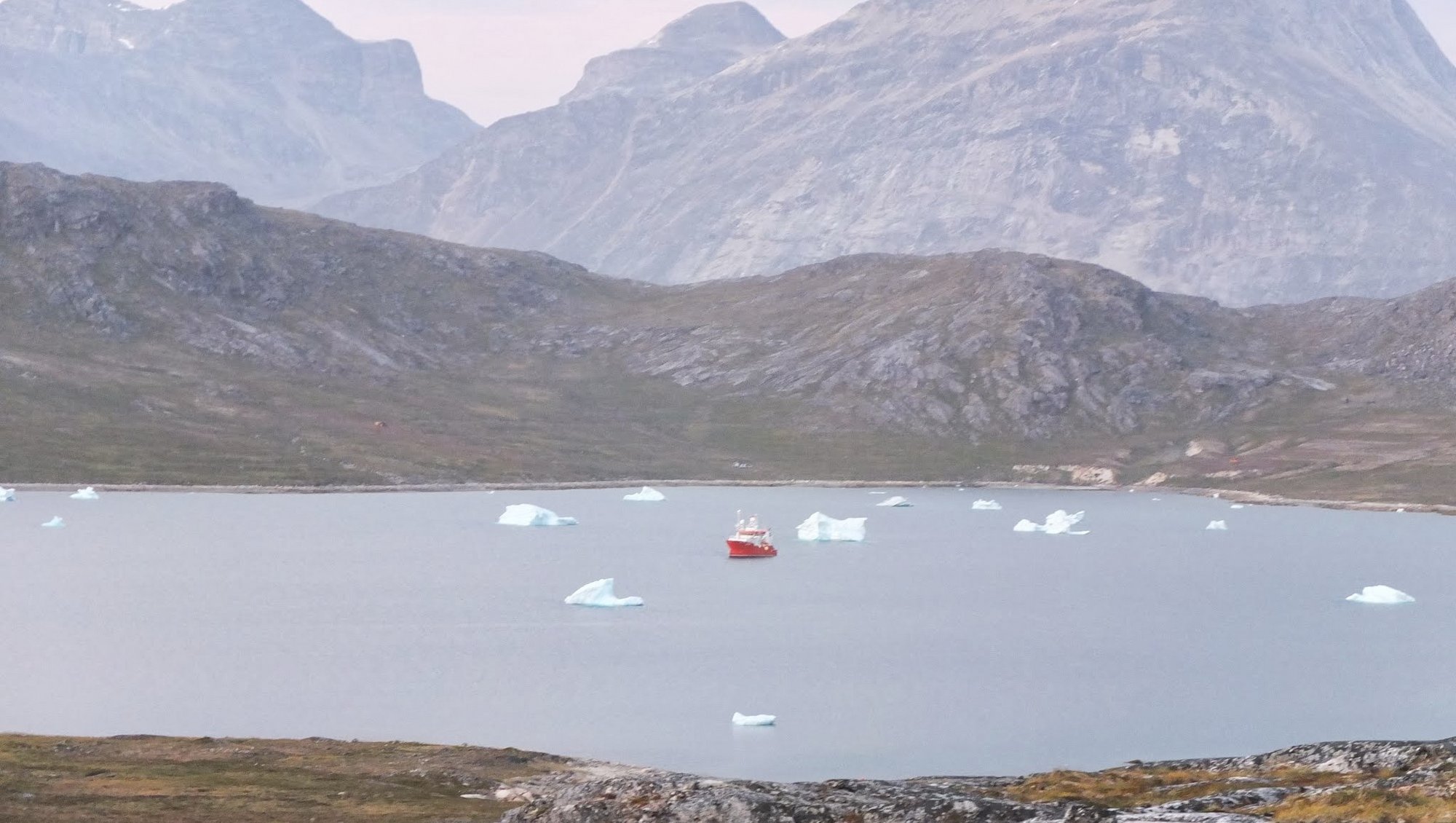
The cruise MSM110 will lead into into three selected fjords along the coastline of East Greenland in August 2022, i.e. during late summer with minimal ice coverage) as an important element of the HORIZON-2020 supported project ECOTIP. ECOTIP aims at improving our understanding of anthropogenic changes in the biological production and diversity in the Arctic marine regions, and their effects on the ecosystem services. Special emphasis is put on evaluating whether a change in the lower trophic levels due to the increased temperature and freshwater outflow or other physico-chemical conditions can trigger an ecosystem tipping cascade that ultimately will change benthic-pelagic coupling, carbon sequestration and fisheries production.
(HDMS Lauge Koch) - cruise report
From September 11 – October 1, 2017, the research vessel ‘Dana’ (Hirtshals, Denmark) served as a platform for a 5576 km long Danish-Greenlandic-Canadian-Italian-Norwegian multi-disciplinary research expedition off Northeast Greenland. The expedition combined research in oceanography/hydrography, bioscience and geoscience. In total, 20 scientists and students from the participating countries partook in the cruise, in addition to 18 crew members. The cruise was funded by the Danish Centre for Marine Research, with co-funding from the Natural Science and Engineering Research Council of Canada.
(RV Dana) - cruise report
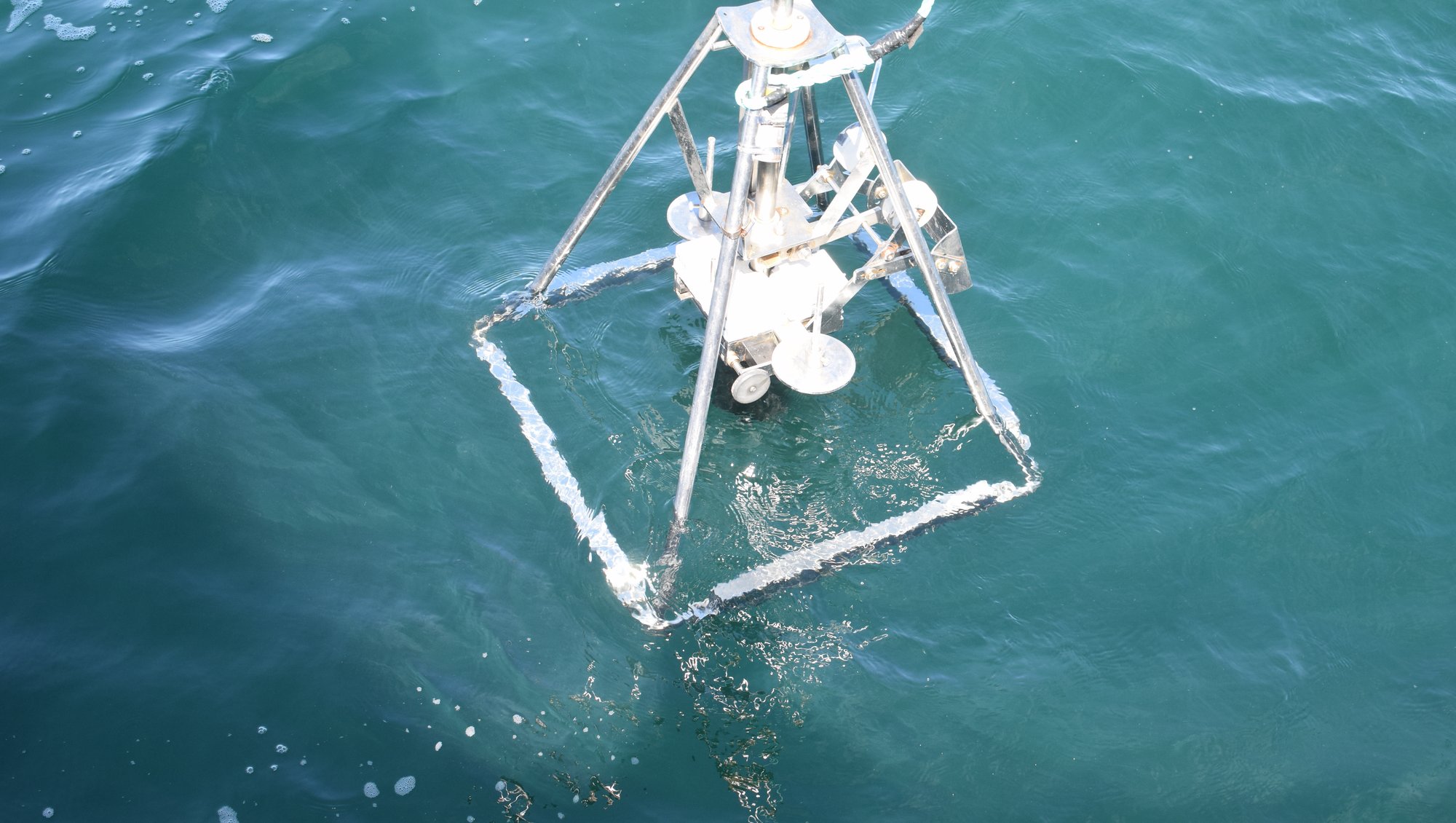
The main purpose of the course was to teach the students with a “learning by doing” philosophy, about marine sciences sampling on board of a real research vessel. Focusing on Geology, Geomicrobiology, Water Chemistry and Biology, the sampling was centered on the recovery of 6-meter long sediment cores at different depths by means of gravity cores. Those cores were processed on board, and pore water and solid-phase subsamples were taken for their further analysis back on shore. These analyses focused on the geochemistry of the sediment (CH4 , SO4 2-, DIC, S2-, Fe2+, VFA and Ca2+ and other ions) and molecular microbiology and organic geochemistry (cell count, DNA analysis, aminoacid characterization) in parallel to a sediment description for later geological analysis. Moreover, CTD and water sampling allowed the analysis of the water chemistry and site description.
(RV Dana) - cruise report
The interaction of the comparatively warm West Greenland Current (WGC) and the melting of Greenland inland ice play a major role not only for regional conditions but also for regional and global climate. The varying strength of the WGC is believed to have a significant impact on Labrador Sea deep-water formation, one of the key components of the Atlantic Meridional Overturning Circulation. The WGC is also important as variations in its strength and composition may be traced back to the inflow of water transported from Arctic Ocean combined with varying strength of the Gulf StreamNorth Atlantic Drift system. Conditions along the West Greenland shelf and in West Greenland fjords are thus directly linked to the larger North Atlantic circulation system. The West Greenland fjords, which are fed by glaciers directly from the Greenland Ice sheet, also provide a strong record of glacier melting. Marine sediment cores form the Godthåbsfjord Complex will in this project be used to trace detailed variations in current system and glacier melting rates in order to improve our understanding of these important factors of the climate system.
(RV Sanna) - cruise report
Projects on board have demonstrated how ship-based research is planned, organized, coordinated and executed, and thus prepared students for future research cruises. The cruise was structured like a research expedition with coordinated sediment sampling by gravity-corer, box-corer and CTD. The research topics addressed included 1) benthic zoology, 2) sedimentology and stratigraphy, 3) pore-water geochemistry, and 4) geomicrobiology. Formally, the course is organized under the Graduate School of Science and Technology (GSST) at Aarhus University.
(RV Dana) - cruise report
The aim of the cruise, which was a contribution to the IPY #120 NORCLIM and IPY #139 APEX initiatives, was to obtain high-resolution marine sediment records of late Holocene regional seasurface temperature (SST) and (sea) ice variability off Newfoundland. The core records are simultaneously thought to provide information on large-scale North Atlantic atmospheric circulation changes. In addition, by using near-shore fjord records of the wind-blown sediment fraction we expect to reconstruct changes in regional storm activity likewise indicative of largescale variations in North Atlantic atmospheric circulation. The work is carried out in close collaboration with scientists from Memorial University, Newfoundland. Various results will be evaluated together with archaeologists working with the Newfoundland settlement history in order to investigate the possible impact of regional ocean- and atmospheric circulation variability on human history.
(RV Akademik Ioffe) - cruise report