
Bitten by the Past: Josephine Publishes Research on Tyrannosaur Scavenging
Josephine Nielsen brought her fascination with dinosaurs into her university studies. Now, she has published the work of her bachelor's thesis - focusing on tyrannosaur bite marks found at the foot of a fellow species member - as a scientific article.

"I think I was like most kids. I collected rocks and fossils and was crazy about dinosaurs. I devoured the books and collected the plastik figures. The only difference between me and the others kids is that I never really let go of it," says Josephine Nielsen, 23, who is currently a Master’s student at the Department of Geoscience at Aarhus University.
While most of her peers packed away their plastic figures along with the rest of their childhood, Josephine has converted her childhood curiosity into hard science. She recently had her bachelor's project on a tyrannosaur bite on a metatarsal bone published as a scientific article.
It is an achievement her supervisor, Christof Pearce, an Associate Professor at the Department of Geoscience, calls outstanding and an inspiring example of pursuing a childhood dream. For Josephine, it’s about holding onto that passion, even when daily studies fill the schedule.
"That’s why I made a deal with myself that I would pursue my interest in dinosaurs during my summer vacations," she says.
Networking in the Camp
That deal has taken her far—from Portugal, where she volunteered in a fossil laboratory, to the USA. In the summer of 2024, the trip went to the "badlands" of Montana. This is a unique geological landscape that is extremely eroded, dry, and almost entirely devoid of plants.
Here, Josephine checked into a camp far away from civilization and mobile coverage. During the day, she dug alongside other volunteers—geology students and a few retired paleontologists—for fossils and bones from prehistoric animals. In the evenings, discussions continued around the tables in the volunteer tent.
"They were intense weeks, but very educational, and it provided me with great professional connections," Josephine explains.
Like Jurassic Park
As erosion constantly peels away new layers of dirt, new fossils emerge naturally. It is a hotspot for paleontologists, geologists, and fossil hunters, and for the geology student from Aarhus, it was a dream come true when she got her hands on actual dinosaur bones.
"You have to imagine that the place was once a lush delta. It’s an amazing feeling to stand there and touch something that hasn't seen the light of day for millions of years. It’s like Jurassic Park—you suddenly realize that these enormous animals actually walked around right here."
She describes her work as a form of detective work.
"How did the animal live, how did it die, and how did the fossil end up here? Those are the mysteries I have to find the answers to."
Help from International Experts
It was under the scorching sun of Montana that Josephine found a hadrosaur vertebra with clear bite marks, which formed the idea for her bachelor's project.
"I knew that this was the time to use the network around me. The leader of the excavation was Denver Fowler, who is the curator at the Badlands Dinosaur Museum in Dickinson, North Dakota. So, I simply asked him for help," she explains.
Although it was a hadrosaur vertebra that sparked the idea, another find ended up being the center of her project: a left metatarsal bone from a large tyrannosaurus found in the Judith River Formation in Montana.
Denver Fowler made the bone available to her and, along with Canadian paleontologist Taia Wyenberg-Henzler and Danish paleontologist Aase Roland Jacobsen from the Science Museums, served as Josephine's external supervisors. This was a crucial alliance to ensure the professional depth of the project.
"I received great help from my internal supervisor at Aarhus University, Christof Pearce, but since his expertise lies in other geological areas, it was vital to get specialists in paleontology on the team. And luckily, they said yes!"
From Large to Small Animals
Josephine spent a large part of the fall of 2024 getting the formal agreements in place. She wrote and submitted the bachelor's project itself in 2025. The ultimate reward came when she published an article based on the project in the journal Evolving Earth.
"It’s a great satisfaction, and it strengthens my experience that communicating knowledge is worthwhile. I’m certainly not finished with that," Josephine says.
However, the large animals will have to step aside for smaller ones as her Master’s thesis approaches. Josephine already knows she will be heading into the field on a research vessel to Iceland. Here, she will study microfossils in seabed cores.
Even though the jump from dinosaurs to tiny marine creatures seems large, it makes perfect sense to the young student.
"It’s going to be about climate, and here, the past is our most important key. For me, there is a direct line from the dinosaurs in Montana to the small fossils near Iceland. By understanding how life and the environment have changed over millions of years, we can better understand the climate changes we see today. It’s the same detective hunt—now it’s just about solving the climate challenges of our shared future," says Josephine Nielsen.
16 Bite marks on a Metatarsal Bone
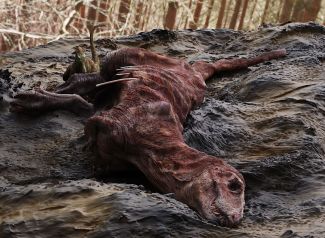
With the help of advanced 3D surface scanning, Josephine Nielsen has mapped 16 unique bite marks using the so-called CM classification system. This forensic approach made it possible to identify the "perpetrator" as a small or juvenile tyrannosaur that had gnawed on a member of its own species significantly larger than itself.
The core of Josephine Nielsen's study is a left metatarsal bone (midfoot bone) bearing clear traces of a prehistoric meal. The bone was found in the Judith River Formation in Montana, USA, which approximately 75–80 million years ago was home to some of the Earth's largest predatory dinosaurs.
The study concludes that the dinosaur bit into a foot bone with very little meat, and since there are no signs of healing, everything suggests that the small tyrannosaur was scavenging a dead carcass. According to Josephine Nielsen, this is not surprising behavior. Tyrannosaurs simply ate whatever they came across—even if they were a member of their own species or a "cousin."
The study confirms previous research on how large predators of the Cretaceous period interacted and utilized the food sources available to them.
Josephine Nielsen did not handle the original bone herself but worked with digital images and a 3D version printed in Aarhus.
The scientific article is published on Evolving Earth.
Read also: 75-Million-year-old Bite Marks…