
75-Million-Year-Old Bite Marks Reveal the Scavengers of the Cretaceous
Newly published research shows that 3D scans reveal smaller dinosaurs did not shy away from feeding on their deceased relatives

While tyrannosaurs are often portrayed as the ultimate, fearsome hunters, a new research study confirms a more practical side of these enormous predators. If the opportunity arose, they didn’t hesitate to act as nature’s scavengers, gnawing on the final remains of a carcass.
This is the conclusion of a new study from the Department of Geoscience at Aarhus University, recently published in the scientific journal Evolving Earth.
The study was conducted by Josephine Nielsen, a Master’s student at the Department of Geoscience. Using 3D scanning, she identified 16 bite marks on a fossilized metatarsal (foot bone) that, more than 75 million years ago, belonged to a giant tyrannosaur.
"I have analyzed the depth, angle, and placement of the marks in a virtual 3D environment and can document that these bite marks did not occur by chance. They are precise impressions from the teeth of a smaller tyrannosaur that fed on a much larger relative," says Josephine Nielsen.
The study provides insight into how nothing went to waste during the age of dinosaurs and that these animals were also scavengers. The tough foot bones were likely eaten late in the decomposition process, after most of the meat was already gone.
"The bone shows no signs of healing after the smaller dinosaur bites into it. Since the marks are located on the foot, where there is very little meat, it suggests that the dinosaur was 'cleaning up' and eating the last remains of an old carcass," she explains.
A Digital Twin with Advantages
Josephine Nielsen did not have the original bone in her hands; instead, she worked with a digital representation and a 3D-printed version created at the Department of Geoscience at Aarhus University.
"It would, of course, have been a special experience to work with the real bone, but it is far too risky to send it through the mail to Denmark," she explains.
The metatarsal is 10 centimeters long and originates from a tyrannosaur that, in life, measured 10–12 meters and weighed several tons. The bone was found by an amateur fossil hunter in the Judith River Formation in Montana—an eroded landscape that serves as a geological archive of a 75-million-year-old ecosystem teeming with dinosaur fossils. The metatarsal has since been donated to the Badlands Dinosaur Museum in Dickinson, North Dakota.
However, creating a digital copy offers significant advantages.
"What makes this study special is not just the knowledge of how the food chain functioned among dinosaurs millions of years ago, but the technique used to read the details. By creating a digital version, I’ve been able to zoom in on very small details. To ensure the analysis was objective, I used the systematic CM (Category-Modifier) classification system. This method categorizes each individual mark based on fixed criteria, allowing us to distinguish everything from glancing tooth strikes to deep crushing bites. It has been like solving an ancient murder mystery, with metatarsal evidence."
Modern Technology Aids Discovery
Canadian paleontologist Taia Wyenberg-Henzler and Denver Fowler, curator at the museum, both served as her external supervisors on the undergraduate project that sparked the published study.
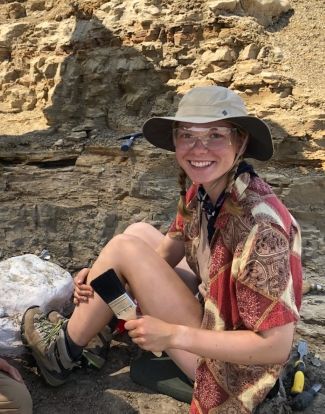
"I got in touch with Denver Fowler and Taia Wyenberg-Henzler while volunteering at an excavation camp in Montana in the summer of 2024. This set me on the path of my project, and it has been incredibly valuable to build international relationships already during my studies," says Josephine Nielsen.
The new study confirms for the geoscience student that modern technology can help us understand dinosaur behavior with even greater precision.
"Now we can extract detailed information about their behavior from quite small traces. By using the CM system, we have established a common scientific language to describe bite marks. This means we are no longer just guessing that 'it looks like a bite,' but can precisely document when and why the small tyrannosaur sank its teeth into the large one," says Josephine Nielsen.
Study Details
Study Type: Paleontological fossil-analyses of tyrannosaur metatarsal
External Partners: Denver Fowler, Taia Wyenberg-Henzler and Aase Roland Jacobsen
The scientific article: Investigating size-asymmetric feeding among tyrannosaurids using tooth marks on a metatarsal from the Judith River Formation, Montana, USA - ScienceDirect
Contact Information:
Master’s student Josephine Nielsen
Institute of Geoscience, Aarhus university
JosephineN02@outlook.com
+45 81 71 43 87
Associate Professor, PhD Christof Pearce
Department of Geoscience, Aarhus University,
christof.pearce@geo.au.dk
+45 93 50 89 15